Morne Trois Pitons National Park, Dominica:
The UNESCO Park
Last updated:
Morne Trois Pitons National Park is the protected core of Dominica's central highlands, a 6,857-hectare reserve named for the three-pinnacled volcano at its heart. The park was inscribed as a UNESCO World Heritage Site in 1997, the first natural site in the Eastern Caribbean to receive that status. Almost every famous landmark in central Dominica sits inside its boundary: the Boiling Lake, Trafalgar Falls, Middleham Falls, the Emerald Pool, Titou Gorge, Freshwater Lake, and Boeri Lake.
If you're spending more than a day in Dominica, you'll be in this park.
Why it's UNESCO
UNESCO inscribed Morne Trois Pitons under two natural-heritage criteria. The volcanic geology is unusually intense for a small area: nine major volcanoes (most inactive), the world's second-largest hot lake, fumaroles and sulphur fields, and three other hot lakes besides the Boiling Lake. The biological diversity is also unusual, with intact rainforest from sea level up to elfin woodland on the ridge tops, and several endemic species (most famously the Sisserou and Jaco parrots, though those are more reliably seen in Morne Diablotin National Park to the north).
In practical terms for visitors, "UNESCO" means: well-marked trails, a Site Pass system that pays for trail maintenance, and a degree of protection that has kept the park genuinely wild. Most of the famous landmarks within the park can only be reached on foot. There are no shortcuts and no roads through the interior.
The headline sites
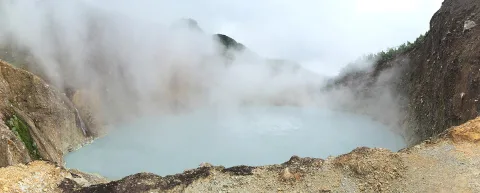
The Boiling Lake
The world's second-largest hot lake, reached on a strenuous 6 to 8 hour out-and-back from Titou Gorge. The hardest day-hike on the island and the trip's centrepiece for most serious hikers.
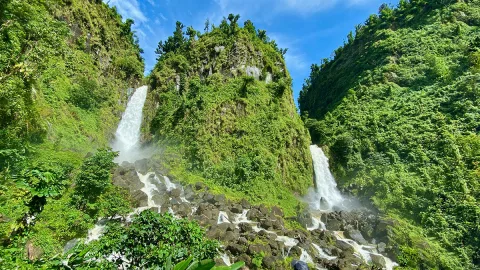
Trafalgar Falls
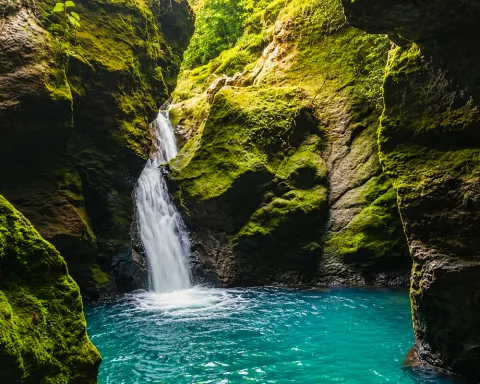
Twin waterfalls (Father and Mother), reached by a 10 to 15 minute walk from the Papillote Visitor Centre. The most-visited landmark in the park.
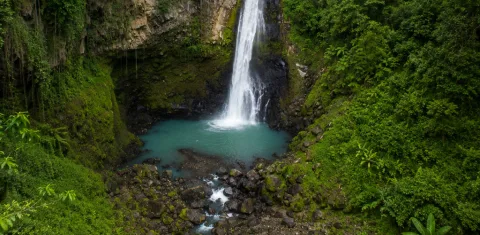
Middleham Falls
80 m single waterfall, reached on a 45 to 60 minute hike from either Sylvania or Cochrane trailhead. Quieter and more dramatic than Trafalgar.
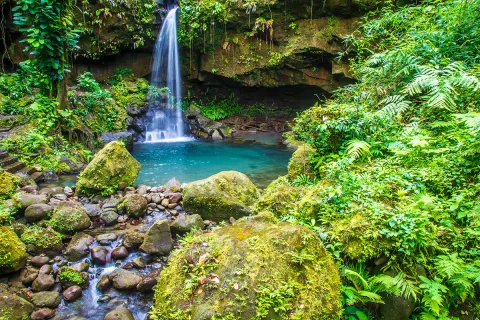
The Emerald Pool
Small waterfall and swimming pool, 10 to 15 minute walk from the visitor centre. The easiest "real rainforest" stop in the park.
Titou Gorge
Narrow basalt slot canyon you swim through. Trailhead for the Boiling Lake hike.
Freshwater Lake and Boeri Lake
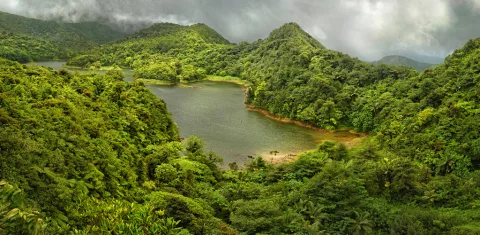
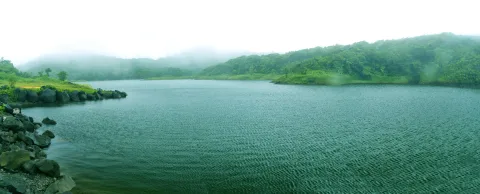
Two crater lakes on the same plateau at 800+ m elevation. Reached on day-hikes from the Freshwater Lake trailhead.
What's the park like to walk in
"I've walked through the park more than really explored it. It's very pretty everywhere you look."
Drew
Most visitors don't see the park as a whole, they see the named sites within it. The terrain between sites is dense rainforest covering steep volcanic ridges, with a handful of marked routes (the Boiling Lake trail, the Boeri-to-Freshwater traverse) cutting through. The forest is genuinely tropical: heliconia, tree ferns, hanging vines, the constant background noise of frogs and insects, and frequent passing rain.
If you want a sense of the park beyond the famous landmarks, three good options:
- The Freshwater Lake loop trail circumnavigates the lake at 760 m elevation. Easy 5 km walk with views down to the south coast on a clear day.
- The Boeri Lake hike from the Freshwater Lake trailhead, roughly 2 to 3 hours round trip, into deeper forest.
- A drive on the cross-island road between Roseau and the airport, which crosses the northern edge of the park with several pull-offs. Less immersive than walking, but a good orientation if you're short on time.
Geology and the volcanic system
The park is built on a still-active volcanic system. The three peaks of Morne Trois Pitons itself are extinct, but the wider system feeds:
- The Boiling Lake. Surface temperatures 82 to 92°C, fed by superheated steam vents.
- The Valley of Desolation. A working sulphur field of bubbling mud pots, fumaroles, and bare rock between Morne Nicholls and the Boiling Lake.
- The hot springs at Wotten Waven (just outside the park boundary, but fed by the same system).
- Three smaller hot lakes in addition to the Boiling Lake, harder to reach without a specialist guide.
This is also why the park's terrain ages so visibly: parts are still being shaped by volcanic activity, while a kilometre away you can be in mature rainforest that hasn't burnt or vented in centuries.
Costs and entry
The park doesn't have an entry gate as such. You enter by visiting one of the named sites, where you'll need a Dominica Site Pass:
- Day pass: US$5
- Week pass: US$12 (the obvious choice for most visitors)
- Annual pass: US$40
The pass also covers most other national-park sites in Dominica, including Cabrits and Morne Diablotin. Buy at any major site entrance or the Forestry Division office in Roseau.
Getting around the park
Most visitors base in or near Roseau and drive to individual park sites:
- Trafalgar Falls and Titou Gorge: ~25 to 30 minutes from Roseau.
- Middleham Falls (Sylvania trailhead): ~25 minutes.
- The Emerald Pool: ~40 minutes via the Layou Valley road.
- Freshwater Lake and Boeri Lake: ~30 to 35 minutes via Laudat.
- Boiling Lake trailhead (Titou Gorge): ~30 minutes plus the 6 to 8 hour hike.
There is no through-road across the park. To get from the south side (Trafalgar, Wotten Waven) to the east side (Emerald Pool, Castle Bruce), you drive around the park, not through it. See getting around Dominica for the practicalities.
Suggested itineraries within the park
One day (highlights)
Morning at Trafalgar Falls, brief stop at Titou Gorge for a swim, afternoon at Wotten Waven hot springs just outside the park boundary.
Two days
Day 1: Trafalgar plus Titou Gorge plus Wotten Waven. Day 2: A real hike. Either Middleham Falls (half day) or Boeri Lake (longer).
Three days
Add the Boiling Lake hike as day 3. The full eight-hour day. This is the canonical three-day Morne Trois Pitons sequence.
Four+ days
A full traverse of the park's main features, with time for the Emerald Pool, Freshwater Lake loop, and a return visit to a favourite waterfall.
Morne Trois Pitons National Park, Dominica – FAQ
Why is Morne Trois Pitons a UNESCO World Heritage Site?
Inscribed in 1997 for its volcanic geology and biological diversity. Nine volcanoes, the world's second-largest hot lake, intact rainforest from sea level to ridge top, and several endemic species. The first natural UNESCO site in the Eastern Caribbean.
What is there to do in Morne Trois Pitons National Park?
Hike to waterfalls and crater lakes, swim through Titou Gorge, do the Boiling Lake hike, walk the Freshwater Lake loop, visit the Emerald Pool. Most visitors spend two to three days exploring the park's named sites.
Do I need a guide to enter the park?
Not for the named sites. Trafalgar Falls, Middleham Falls, the Emerald Pool, Freshwater Lake, Boeri Lake, and Titou Gorge are all signposted and walkable independently. Yes for the Boiling Lake, which is genuinely confusing in the Valley of Desolation.
How much time do I need for the park?
One day for the headlines (Trafalgar plus Emerald Pool plus a swim). Three days to do justice to the park's main hikes including the Boiling Lake.
Can you camp in Morne Trois Pitons?
Limited. The park doesn't run developed campsites. The longer hiking routes (Waitukubuli National Trail Segments 4 to 5 cross the park) include rural homestays and basic shelters. Casual wild camping is not allowed.
What's the difference between Morne Trois Pitons and Morne Diablotin National Parks?
Morne Trois Pitons is the central park with most of the famous landmarks (waterfalls, the Boiling Lake, crater lakes). Morne Diablotin National Park is the northern park built around Dominica's highest peak, better for bird watching (Sisserou and Jaco parrots) and the Syndicate Nature Trail.
Quick look
- Area
- 6,857 hectares (16,940 acres)
- Established
- 1975 (national park), 1997 (UNESCO World Heritage)
- Highest point
- Morne Trois Pitons, 1,387 m (4,550 ft)
- Site Pass
- Required to enter named sites (US$5/$12/$40)
- Best season
- Dry season (December to April)