The History of Dominica:
From Kalinago to Independence
Last updated:
Dominica's history follows the broad arc of the Eastern Caribbean: Indigenous peoples, European contact, two centuries of contested colonial rule, slavery, emancipation, and a long path to independence. What sets it apart is the duration and effectiveness of Indigenous resistance, the unusual juxtaposition of French and British cultural influence, and the survival of the only remaining Indigenous Caribbean reserve in the region.
Pre-Columbian Dominica
The earliest known human inhabitants of Dominica were Arawak-speaking peoples who arrived from the South American mainland by around 400 to 600 AD. Archaeological evidence (pottery, settlement sites, shell middens) places them across the island for several centuries before the arrival of the Kalinago (also called Caribs in older sources), who migrated from the same continental origins by around 1200 AD and largely replaced or absorbed the Arawak population.
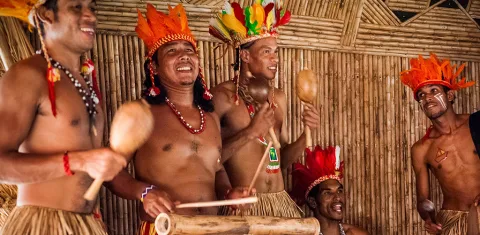
The Kalinago organised themselves in coastal villages, fished, farmed cassava and other root crops, and built ocean-going canoes that allowed for inter-island travel and trade. By the time of European contact in 1493, Dominica was firmly Kalinago territory.
European contact: 1493
Christopher Columbus's second voyage sighted Dominica on Sunday, 3 November 1493. The name Dominica comes from the Latin for "Sunday" (dies Dominica), the day of the sighting. Columbus did not land. The early Spanish administration showed little interest in the small mountainous island, and Dominica remained largely outside European control for most of the 16th and 17th centuries.
Kalinago resistance was a major factor. Unlike the larger Greater Antilles islands, where Indigenous populations were rapidly conquered or wiped out by disease and conflict, Dominica's mountainous interior gave the Kalinago defensible terrain that European powers couldn't easily penetrate. Kalinago raiders attacked European settlements on neighbouring islands well into the 18th century.
In 1660, England and France formally recognised Dominica (along with St Vincent) as neutral and reserved for the Kalinago, an unusual treaty acknowledgment of Indigenous sovereignty in the Eastern Caribbean.
French and British contest
The neutrality didn't hold. From the early 1700s, French settlers began establishing small plantations along the coast, taking advantage of the lack of formal British control. They introduced sugar, coffee and cocoa cultivation, brought enslaved Africans as plantation labour, and seeded the French language and Catholic religion that became permanent parts of Dominican culture.
In 1763, the Treaty of Paris ending the Seven Years' War formally transferred Dominica to British control. Britain established the colonial administrative apparatus, English-language institutions, and a steady stream of British settlers, though French cultural influence remained dominant in rural areas.
Dominica changed hands several more times during the late 18th century:
- 1778: French recapture during the American Revolutionary War.
- 1783: Returned to Britain by the second Treaty of Paris.
- 1795 and 1805: Brief French raids and occupations.
By the early 19th century, Dominica was firmly within the British colonial system, though the linguistic and cultural mix that had developed over the previous century survived as the foundation of modern Kwéyòl-speaking, Catholic, Creole Dominica.
Slavery and emancipation
Africans were brought to Dominica as enslaved plantation labour from the late 1600s, primarily for sugar, coffee and cocoa estates on the coastal plains. The mountainous interior, however, gave enslaved people opportunities for escape that didn't exist on flatter Caribbean islands.
Maroon communities (groups of escaped enslaved Africans) established themselves in Dominica's central highlands during the 18th century, in some cases mixing with Kalinago communities. Maroon resistance, including raids on plantations, continued into the 1810s and 1820s.
The British Slavery Abolition Act of 1833 abolished slavery throughout the British Empire. In Dominica, formal emancipation came on 1 August 1834, with full freedom granted (after a four-year apprenticeship period) on 1 August 1838. The dates are still observed as Emancipation Day holidays.
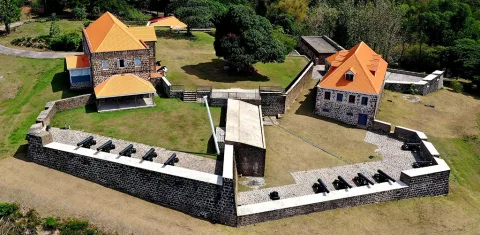
The most consequential single event in Dominica's slavery history happened earlier, however: the 1802 Mutiny of the Eighth West India Regiment at Fort Shirley. African soldiers, many formerly enslaved, rebelled against British officers and forced parliamentary reforms granting them the same status as European troops. It was an early step toward broader emancipation. See Fort Shirley for the detailed account.
The Carib Reserve and Kalinago survival
By the late 19th century, the Kalinago population had been reduced to a few hundred individuals concentrated on Dominica's east coast. In 1903, the British colonial administration formally set aside 3,700 acres as the Carib Reserve, a remarkable piece of legislation that, despite its colonial framing, preserved a continuous Kalinago land base into the modern era.
The reserve was renamed the Kalinago Territory in 2015 to reflect the people's preferred self-designation. The community remains the only Indigenous Caribbean reserve still in existence.
Path to independence
Dominica's path through the 20th century followed the broader Caribbean trajectory toward self-government:
- 1958: Joined the short-lived West Indies Federation, a British attempt at regional political union.
- 1962: Federation collapsed; Dominica returned to direct colonial rule.
- 1967: Granted Associated State status with internal self-government.
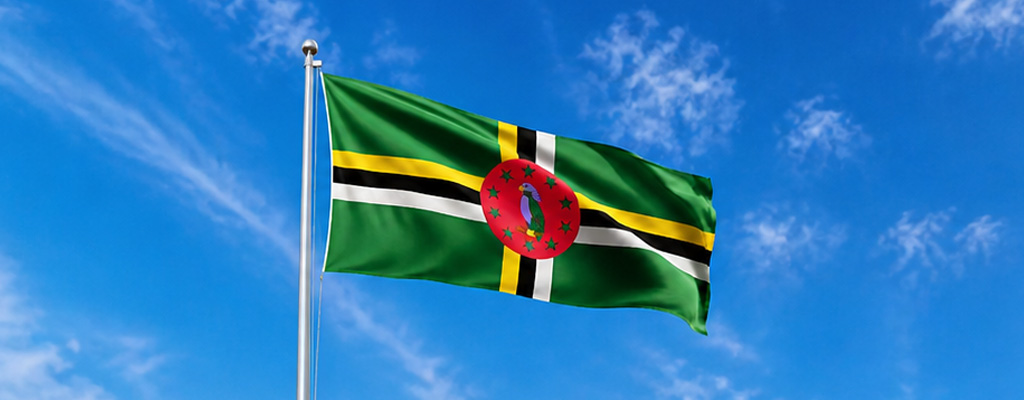
- 1978 (3 November): Full independence as the Commonwealth of Dominica, exactly 485 years after Columbus's first sighting.
Dominica became a parliamentary republic, with a President as ceremonial head of state and a Prime Minister leading the elected government. Eugenia Charles, who became Prime Minister in 1980, served three consecutive terms (1980 to 1995) and was the Caribbean's first elected female head of government.
Modern Dominica
Post-independence, Dominica's politics have been small-scale, stable, and democratic. The two main parties are the Dominica Labour Party (in government for most of the past two decades) and the United Workers' Party. Elections are held regularly and contested actively.
Two natural disasters have shaped recent history disproportionately:
- Hurricane David (1979), just months after independence, caused widespread damage and reshaped the country's early development.
- Hurricane Maria (September 2017), a Category 5 storm, damaged or destroyed over 90% of buildings on the island. Recovery has been steady but ongoing, with substantial rebuilding of infrastructure, accommodation and agricultural sectors.
The economy has gradually shifted from a banana-export base toward eco-tourism, regional services, and citizenship-by-investment programmes.
History of Dominica – FAQ
When did Christopher Columbus arrive in Dominica?
Sunday, 3 November 1493, on his second voyage. The island was named Dominica (Latin for "Sunday") in reference to the day of sighting. Columbus did not land.
When did Dominica gain independence?
3 November 1978, from the United Kingdom. Dominica became a parliamentary republic within the Commonwealth of Nations.
How long was Dominica a British colony?
Formally from 1763 to 1978 (215 years), though Dominica also experienced French settlement and brief French occupations during that period.
Who are the Kalinago people?
The Indigenous people of the Eastern Caribbean, descendants of populations who arrived from mainland South America by around 1200 AD. Roughly 3,000 Kalinago live in the Kalinago Territory on Dominica's east coast, the only remaining Indigenous Caribbean reserve.
When was slavery abolished in Dominica?
The British Slavery Abolition Act of 1833 took effect in Dominica on 1 August 1834, with full freedom granted (after a four-year apprenticeship period) on 1 August 1838. Both dates remain national holidays.
What is Hurricane Maria's place in Dominica's history?
Hurricane Maria (September 2017), a Category 5 storm, caused damage to over 90% of buildings on the island and remains the most consequential single event in modern Dominican history. Recovery efforts continue.