Whale Watching in Dominica:
Sperm Whales Year-Round
Last updated:

Must Do

Sperm whales live here year-round — not passing through, resident. Go out on a calm morning and the chances of seeing one are genuinely high.
Dominica is one of the only places in the world where sperm whales are resident year-round. The deep water close to the leeward (west) coast is feeding habitat for several distinct family pods, which means whale-watching trips here have a strong sighting rate and an unusual depth of behaviour: tail slaps, breaches, and the occasional sperm whale "rosette" (multiple whales socialising at the surface) are encountered regularly. Dolphin sightings (spinner, spotted, and bottlenose) are common on the same trips, and pilot whales and false killer whales appear seasonally.
For travellers visiting Dominica without a specific dive or hike focus, a whale-watching trip is the single most-rewarding half-day on the water.
Quick facts
| Resident species | Sperm whales (year-round) |
| Common encounters | Spinner dolphins, spotted dolphins, bottlenose dolphins, pilot whales |
| Best season | November to March (calmest seas) |
| Trip duration | 3 to 4 hours |
| Cost per person | US$60 to $90 |
| Departure points | Roseau, Castle Comfort |
| Sighting rate | High but never guaranteed |
Why Dominica is unusually good
Most of the world's whale-watching destinations are seasonal. The whales pass through, you go for a window of a few months, and the rest of the year there's nothing to see. Dominica is different. The leeward-coast waters are deep enough close to shore (300+ m within a kilometre) and rich enough in squid for sperm whale family pods to live here permanently. Long-term research (Dominica Sperm Whale Project, since 2005) has identified individual whales by tail markings and tracked specific family groups over decades.
Practically, this means you can book a whale-watching trip in any month of the year with a reasonable chance of a sighting. Conditions vary by season, but the whales themselves are always nearby.
When to go
- November to March (peak). Calmest seas, most consistent tour schedules, best window for first-time visitors. Highest sighting rates.
- April to June (shoulder). Good conditions, sighting rate similar to peak.
- July to October (low). Trips run when sea conditions allow. Hurricane season can disrupt schedules. Whales are still around but less reliably accessible.
For a full month-by-month picture of conditions, see the best time to visit Dominica.
What you'll see
Sperm whales
The headline species. Adult sperm whales are 15 to 18 m long and weigh up to 50 tonnes. The pods around Dominica are typically family groups (mothers, calves, juveniles, with adult males moving through more occasionally). Common surface behaviours:
- Surface logging. Whales rest at the surface, breathing every 10 to 15 seconds.
- Tail slap (lobtailing). A whale slapping its fluke down on the water, audible from a distance.
- The "rosette". Multiple whales clustering head-down with tails radiating out. Social behaviour, particularly memorable.
- Breaching. Whole-body leaps. Less common but occasional.
You'll often hear the whales before you see them. Underwater hydrophones are standard equipment on most tour boats and the clicking calls (sperm whale echolocation) are loud enough to feel as well as hear.
Dolphins
"My wife and I saw two pods of dolphins while out on a dive boat in Soufriere. It was around 3-ish and the light was perfect. We stayed out there for 20 minutes just watching the dolphins."
Drew
Several dolphin species are common in the same waters. Spinner dolphins (most likely sighting), spotted dolphins, and occasionally bottlenose dolphins appear in pods of 20 to 100+. Sightings are often unplanned encounters during whale tours, dive trips, or open-water transfers.
Pilot whales and other species
Short-finned pilot whales appear seasonally, often in larger groups. Less commonly, false killer whales, melon-headed whales, and Cuvier's beaked whales are documented in the waters off Dominica.
How tours work
Standard format:
- Boat departs Roseau or Castle Comfort, typically 9 AM and 2 PM.
- Run out to deep water close to shore (within 30 minutes).
- Crew uses underwater hydrophones to locate whale pods.
- Once a pod is located, the boat positions itself respectfully and observers watch from the deck.
- Multiple positions over 2 to 3 hours of watching, depending on whale movement.
- Return to port.
Most trips run 3 to 4 hours total and have a sighting rate of 70%+. Operators are good at locating whales but no trip can guarantee an encounter.
Operators
Several Roseau-area operators run whale-watching trips. Most are also dive operators with the same boats and crews. Standard rates are US$60 to $90 per person, including refreshments. Booking is recommended a day or two ahead in peak season. Cruise-day pickups directly from the port are commonly available.
Two operators worth shortlisting (the wider operator scene rotates; check current reviews):
- Anchorage Hotel and Dive Centre (Castle Comfort): long-running, established whale-watching operation.
- Dive Dominica (Castle Comfort): combined dive and whale-watching trips.
Cost and access
- Standard tour: US$60 to $90 per person.
- Full-day or "deluxe" tours with extras (snorkelling, lunch): US$120 to $180.
- Refreshments typically included. Bring layers.
- No guarantee of a sighting, but most operators will offer a discounted or rescheduled trip if no whales are seen.
Pair with
- Whale watching morning, hot springs afternoon. A relaxed day on the water followed by recovery.
- Whale watching plus scuba diving. Many operators offer combined trips.
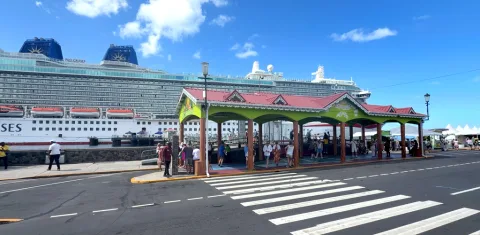
- Cruise day: see the cruise port guide for fitting whale watching into a port window. A 6-hour port stop is the practical minimum.
Practical tips
- Take motion sickness medication if you're prone. Sea conditions can be choppy, especially outside peak season.
- Bring a light layer. Even tropical sea winds get cold over a 3-hour trip.
- Polarised sunglasses make whale spotting much easier.
- Don't expect cruise-style amenities. These are working dive boats, not tourist platforms.
- Cameras need long lenses. A phone is fine for deck photos but won't capture whales at sensible distances.
Whale Watching in Dominica – FAQ
Can you see whales in Dominica year-round?
Yes. Sperm whales are resident off Dominica's leeward coast. Tours run in any month, though sea conditions are best November to March.
What's the sighting rate for whale-watching in Dominica?
Around 70 to 90% for sperm whales over an average 3-hour trip. Dolphins and other cetaceans are seen on most trips. No trip can fully guarantee a sighting.
How much does whale-watching in Dominica cost?
US$60 to $90 per person for a standard 3 to 4 hour trip. Full-day combined trips run US$120 to $180.
Can you swim with sperm whales in Dominica?
Limited. Dominica issues a small number of swim-with-whales permits each year for licensed operators on extended multi-day trips, but standard tour boats observe from the deck only. If you specifically want a swim experience, contact operators well in advance and expect significant cost.
Is whale-watching suitable for children?
Yes, generally. Boats are stable, trips are 3 to 4 hours, and seeing whales is universally engaging. Younger children may struggle with seasickness or attention span; pack medication and snacks accordingly.
Can I do whale-watching from a cruise?
Yes. Most operators arrange direct pickup from the cruise port. A 6-hour port window is the minimum.