Fort Shirley, Dominica:
Restored 18th-Century British Garrison
Last updated:
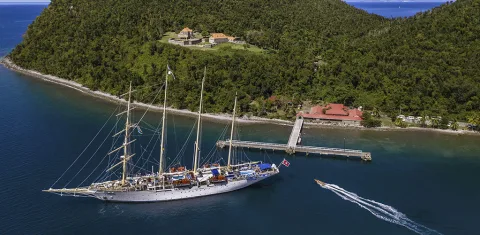
Fort Shirley is the restored 18th-century British military complex on the Cabrits promontory, just north of Portsmouth on Dominica's leeward coast. Built between 1770 and 1815 to defend Prince Rupert Bay, abandoned in 1854, and progressively reclaimed from the rainforest from the 1980s onwards by Dominican historian Lennox Honychurch, the fort is now one of the best-preserved colonial military sites in the Eastern Caribbean. It also holds a significant place in the regional history of slavery and emancipation, thanks to a 1802 mutiny that forced Britain to grant African soldiers full military rights.
Why visit
The fort itself is photogenic and the views from the walls reach Prince Rupert Bay and the Caribbean Sea. But the real reason to visit is the history. Three layers worth understanding:
- British naval defence of the eastern Caribbean against French and Spanish rivals during the colonial wars of the 18th century.
- The 1802 Mutiny of the Eighth West India Regiment, when African soldiers stationed at Fort Shirley rebelled against British officers and forced the empire to grant them full status as soldiers, a step on the way to British abolition (1834).
- The forest reclamation and modern restoration that turned a ruin back into a visitable site.
"The fort is in good condition and the views from the walls are amazing. Get a shot next to the cannons. There are trails that run around the fort too, nothing strenuous but worth a look."
Drew
The 1802 Mutiny
The most consequential event to happen at Fort Shirley. Briefly:
The Eighth West India Regiment was a unit of African soldiers, many of them formerly enslaved, who were stationed at Fort Shirley as part of British colonial forces. They were paid less than European soldiers, denied the same legal status, and feared being sold back into slavery (a fate that had befallen other West India regiment soldiers).
In April 1802, the regiment rebelled. They seized the fort, killed several British officers, and held the position for three days. The mutiny was eventually put down (with several mutineers executed), but it forced Britain to confront the legal status of African soldiers in its colonial military. Within a few months, Parliament passed legislation granting all West India regiment soldiers the same status as European troops, including freedom from re-enslavement. The reform is widely seen as an early step toward broader emancipation.
The story is told in detail at the museum inside the restored Officers' Quarters.
What's at the fort
- The barracks, restored, with cannons set in their original wall positions.
- The Officers' Quarters, now housing a museum about the fort, the regiment, and the wider Cabrits story.
- The Powder Magazine and several other military structures in varying states of restoration.
- A reconstructed slave village below the fort, acknowledging the African labour that built the complex.
- Interpretive signs along the paths giving context for each structure.
The entire complex sits in mature rainforest that has reclaimed parts of the original site. Walking between buildings you pass through forest where you can still see the outlines of buildings yet to be restored.
Visiting practicalities
The fort is part of Cabrits National Park. Entry is by Site Pass.
- Walking through the fort: allow 60 to 90 minutes for the main restored areas.
- Including a trail: add 30 to 75 minutes for one of the East or West Cabrit summit trails.
- Plus the marine area: another hour if you snorkel.
Most visitors do the fort plus one peak trail in 2 to 3 hours total.
There is a small café and toilets at the visitor centre near the entrance. Bring water if you're walking the trails as well.
Photography
The most-photographed views are:
- The cannons on the bay-side wall with Prince Rupert Bay behind.
- The restored barracks at sunset. Best light is the last 90 minutes of daylight.
- The view from the East Cabrit trail looking back at the fort with the sea behind.
The fort closes around dusk; if you want sunset shots, time your visit accordingly.
Pair with
The natural pairings are:
- Indian River boat trip in the morning (~10 minutes from Cabrits), lunch in Portsmouth, fort in the afternoon.
- A north-coast day including the fort, Batibou Beach, and Calibishie.
- A history-focused day combining the fort with the Kalinago Territory (long drive but coverable in one full day).
Cost and access
- Site Pass: US$5 day, US$12 week, US$40 annual.
- Free parking at the visitor centre.
- Wheelchair access is limited beyond the visitor centre. Some restored areas have steps; the trails are not wheelchair-friendly.
- Mobile signal is decent on the lower fort, less so on the trails.
Fort Shirley, Dominica – FAQ
What is Fort Shirley famous for?
The 1802 Mutiny of the Eighth West India Regiment, when African soldiers rebelled and forced Britain to grant them full status. One of the most consequential events in Caribbean military history. The fort itself is also one of the best-preserved colonial military complexes in the Eastern Caribbean.
How long do you need at Fort Shirley?
1 to 2 hours for the restored areas of the fort. 3 to 4 hours if you also walk one of the Cabrit peak trails or visit the marine area.
Is Fort Shirley worth visiting?
Yes, especially for travellers interested in colonial Caribbean history or wanting a non-rainforest cultural day. The combination of restoration quality, story, and views earns the visit.
Can you visit Fort Shirley independently?
Yes. No guide required. Interpretive signs along the paths and exhibits at the Officers' Quarters museum cover the history. Guided tours are available if you want more depth.
Is Fort Shirley wheelchair accessible?
Partially. The visitor centre and the lower fort area are accessible. Some of the restored buildings have steps and uneven stone surfaces. The trails up the peaks are not wheelchair-friendly.
Is the fort the same as Cabrits National Park?
No, but Fort Shirley is the main attraction within Cabrits National Park. The park also includes the two Cabrit peaks (with their trails) and the Cabrits Marine Section. Most visitors who say they visited Cabrits mean they visited the fort.
Quick look
- Built
- 1770 to 1815
- Abandoned
- 1854
- Restoration started
- 1980s, ongoing
- From Portsmouth
- 5 minutes by car
- From Roseau
- ~1 hour
- Site Pass
- Required (US$5 day / US$12 week / US$40 annual)
- Time at site
- 1 to 2 hours